
From Supplements to Superfoods: Vetting 'Complete' Dog Food Claims
Search our dog listings!
Intro
Choosing a healthy dog food feels confusing because marketing uses words like "superfood," "natural," and "human grade" a lot.
Those words can sound great, but they don't always tell you whether the food meets the real nutrient needs of your dog.
This post gives clear, simple steps to spot true "complete and balanced" foods, what questions to ask brands, and how to handle supplements and toppers safely.
Dogs near Columbus

DUCKY
Mixed Breed
🇺🇸
Canal Winchester, Ohio
female, large, young
Mixed Breed
Canal Winchester, Ohio

FINN
Australian Cattle Dog Blue Heeler, Bluetick Coonhound
🇺🇸
Plain City, Ohio
male, medium, baby
Australian Cattle Dog Blue Heeler, Bluetick Coonhound
Plain City, Ohio

HANNAH
Shetland Sheepdog Sheltie, Australian Shepherd
🇺🇸
Dublin, Ohio
female, medium, baby
Shetland Sheepdog Sheltie, Australian Shepherd
Dublin, Ohio

YAHOO
Mixed Breed
🇺🇸
Canal Winchester, Ohio
male, large, baby
Mixed Breed
Canal Winchester, Ohio

DERAN
Boxer
🇺🇸
Columbus, Ohio
male, small, adult
Boxer
Columbus, Ohio

RUSSELL
Chihuahua, Mixed Breed
🇺🇸
Plain City, Ohio
male, small, baby
Chihuahua, Mixed Breed
Plain City, Ohio

CALYPSO
Mixed Breed
🇺🇸
Canal Winchester, Ohio
female, medium, baby
Mixed Breed
Canal Winchester, Ohio

CLOONEY
Newfoundland Dog
🇺🇸
Columbus, Ohio
male, large, senior
Newfoundland Dog
Columbus, Ohio

BEAST BOY
Mixed Breed
🇺🇸
Canal Winchester, Ohio
male, large, baby
Mixed Breed
Canal Winchester, Ohio

YELLOW ROSES
Mixed Breed
🇺🇸
Canal Winchester, Ohio
male, large, baby
Mixed Breed
Canal Winchester, Ohio

MAMMOTH
Mixed Breed
🇺🇸
Canal Winchester, Ohio
male, large, baby
Mixed Breed
Canal Winchester, Ohio

ROOK
Pug, Beagle
🇺🇸
Columbus, Ohio
female, small, baby
Pug, Beagle
Columbus, Ohio

LAKOTA
Akita, Keeshond
🇺🇸
Plain City, Ohio
female, medium, adult
Akita, Keeshond
Plain City, Ohio

TINKER
Dachshund
🇺🇸
West Jefferson, Ohio
female, small, senior
Dachshund
West Jefferson, Ohio

SOPHIE
Mixed Breed
🇺🇸
Canal Winchester, Ohio
female, medium, baby
Mixed Breed
Canal Winchester, Ohio

JON SNOW
German Shepherd Dog
🇺🇸
Canal Winchester, Ohio
male, large, adult
German Shepherd Dog
Canal Winchester, Ohio

DUKE
Mixed Breed
🇺🇸
Canal Winchester, Ohio
male, small, adult
Mixed Breed
Canal Winchester, Ohio

SPOTS
American Bulldog, Terrier
🇺🇸
West Jefferson, Ohio
male, large, adult
American Bulldog, Terrier
West Jefferson, Ohio

SPIKE
Shepherd, Corgi
🇺🇸
Plain City, Ohio
male, medium, adult
Shepherd, Corgi
Plain City, Ohio

VERA
Maltese, Shih Tzu
🇺🇸
Lewis Center, Ohio
female, small, baby
Maltese, Shih Tzu
Lewis Center, Ohio
What "Complete and Balanced" Actually Means
"Complete and balanced" is a formal claim that must be backed by a nutritional statement for a specific life stage.
In the U.S. that statement follows AAFCO model regulations and says the food meets nutrient needs for, for example, adult maintenance or growth.
A product can prove this two ways: "formulated to meet" nutrient profiles on paper, or by passing AAFCO feeding trials with real dogs — feeding trials give stronger real-world proof.
Life Stages and Large-Breed Puppies
Make sure the adequacy statement matches your dog's life stage, and if you have a big puppy the label should say it is for "growth including large size dogs."
Large-breed puppies need controlled calcium and energy to avoid orthopedic problems, so ask the brand for calcium and phosphorus expressed per 1,000 kcal.
If a food is labeled for "all life stages" it meets growth standards and may be higher in calories and minerals than some adult dogs need, so portion control matters.
Read the Label Like a Vet
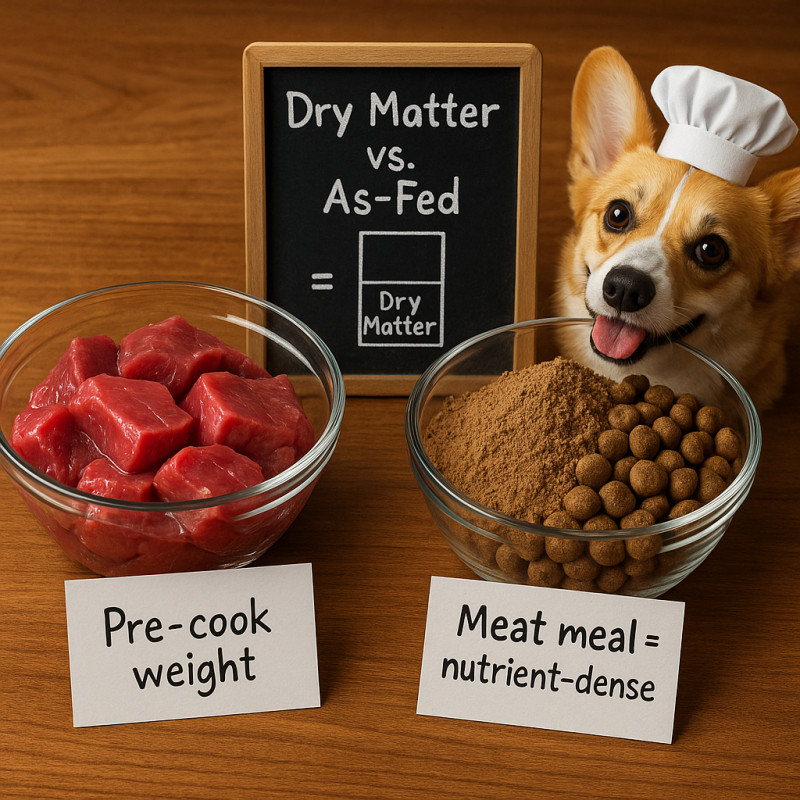
Labels must include ingredient list (ingredients are listed by pre-cooking weight), guaranteed analysis, nutritional adequacy statement, feeding directions, and calorie content.
Remember fresh meat can appear first because of moisture, while meat meals are more nutrient-dense after cooking — ingredient order alone isn't a quality score.
Marketing claims like "natural," "human grade," or "superfood" have specific limits or none at all, so treat them as advertising unless the company provides data.
Simple Math: Dry Matter and Per 1,000 kcal
Because moisture hides nutrients, compare foods on a dry matter (DM) basis: DM% = 100 − moisture%.
To convert a nutrient listed as percent as-fed to DM: nutrient% on DM = (nutrient% as-fed ÷ DM%) × 100.
To compare energy-corrected values, convert nutrients to grams per 1,000 kcal using the food's kcal/kg; this helps check calcium, phosphorus, and amino acids against AAFCO/FEDIAF or veterinary targets.
Vet the Brand: Key Questions to Ask
Use the WSAVA-style questions to assess a company's nutrition know-how and quality controls.
- Who formulates your diets? Do you have board-certified nutritionists or PhD animal nutritionists on staff?
- Do you run AAFCO feeding trials or publish digestibility data?
- Can you provide a typical nutrient analysis (as-fed and dry matter) and calorie content?
- What QA programs exist: supplier audits, mycotoxin screening, fat oxidation testing, microbiology checks, and traceability?
- Do you share batch codes, recall history, and technical support for vets/owners?
Superfoods, Toppers, and Pixie Dust
"Superfood" has no regulatory meaning; small amounts of blueberries, turmeric, or kelp in a kibble are often decorative not therapeutic.
Functional add-ins like glucosamine, chondroitin, or turmeric are frequently under-dosed in dry food compared with levels used in studies.
For probiotics look for named strains and guaranteed CFU through end of shelf life; for fish oil check EPA+DHA mg per kg of body weight rather than trusting vague "omega" claims.
Supplements and Stacking Risks
Don't add multivitamins, extra calcium, or iodine-rich kelp to a complete diet without veterinary advice — too much of some nutrients can cause harm.
If you plan to use fish oil, calculate mg EPA+DHA per kg body weight and coordinate with your vet to avoid overfeeding calories or causing side effects.
Use separate, tested supplements for therapeutic doses (like joint products) rather than relying on the tiny amounts in many kibbles.
Watch for Boutique/Grain-Free Concerns
Some boutique or grain-free diets high in pulses or exotic proteins have been linked to a possible risk for diet-associated heart issues in certain dogs.
If you choose an atypical formula, ask for amino acid profiles (taurine), feeding trials, and digestibility data, and discuss the choice with your veterinarian, especially for breeds at risk.
Practical Checklist: How to Pick and Trial a Food
Follow these steps to find a trustworthy formula and test it safely.
- Confirm the AAFCO/FEDIAF adequacy statement matches your dog’s life stage (and large-breed growth if needed).
- Prefer feeding-trial-proven foods or ask for typical analysis and ME; convert to dry matter and per 1,000 kcal to compare key nutrients.
- Use WSAVA questions to vet the manufacturer’s expertise, QA, and transparency.
- Treat superfood claims skeptically unless dosages are provided; avoid stacking supplements unless directed by a vet.
- Transition slowly over 5–7 days, monitor stool, energy, and body condition score, and weigh monthly.
When to Call the Vet or a Nutritionist
Seek veterinary guidance for puppies (especially large breeds), pregnant or nursing dogs, or any pet with heart, kidney, liver, endocrine, digestive, or weight problems.
Board-certified veterinary nutritionists can create balanced home-cooked diets or evaluate unusual commercial choices.
If your dog has loose stool, weight changes, or low energy after a diet switch, check with your veterinarian rather than guessing.
Final thought
Marketing can be loud, but true nutritional quality is quiet and math-based: verify the adequacy statement, ask for typical analyses and calories, convert nutrients to dry matter and per 1,000 kcal, and demand transparency from brands.
Monitor your dog's body condition and stool, transition foods slowly, and partner with your veterinarian when in doubt.
If you want a short list of questions to ask a specific brand, I can draft one you can copy and send to their customer support.
Quick links
For more details visit the official pages: AAFCO: Understanding Pet Food, WSAVA: Selecting the Best Food for Your Pet, and Tufts Petfoodology: How to Pick a Pet Food.
Search our dog listings!
Back to pet blog