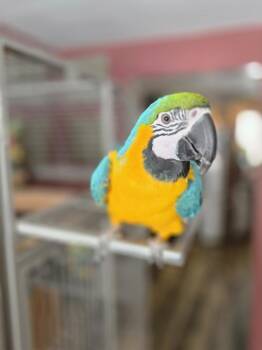
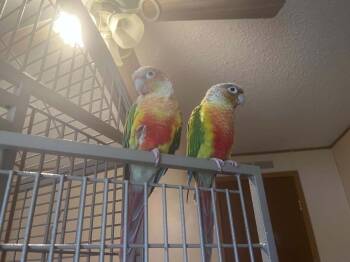
Looking for double the love? Mojo and Kiwi are a pair of best friends looking for a home where they can continue to grow, flourish and share their affection! Because the recently arrives at their foster home, they are currently a little shy while adjusting to their new surroundings. However, under that initial timidness are two wonderful little personalities waiting to blossum with a patient and loving caretaker.
Their prior owner shared that both boys (gender is unconfirmed) know how to step up. Mojo gives birdie kisses. And they both enjoy head scratches once they get to know you.
About the species: Green-cheeked Conures (Pyrrhura molinae) are small South American parrots known for their playful personalities, intelligence, and affectionate nature. Native to the forests and woodlands of Bolivia, Brazil, Argentina, and Paraguay, they are recognized by their grayish-brown heads, green wings, maroon tails, and distinctive scalloped chest feathers. Responsible aviculture has produced several beautiful color mutations, including cinnamon, turquoise, pineapple, and yellow-sided, that are commonly seen in companion birds.
Green-cheeked Conures are curious, energetic companions that thrive on interaction with their caregivers. They often enjoy climbing, exploring, foraging, and learning new behaviors, making daily mental enrichment and out-of-cage time important for their well-being. While they can be vocal, they are generally quieter than many other conure species and are more likely to communicate through chirps, squeaks, and expressive body language than through loud, prolonged calls. Unlike cockatoos and African Greys, Green-cheeked Conures are not considered a dusty species and produce very little feather powder.
With proper care, companion Green-cheeked Conures commonly live 20–30 years, making them a long-term commitment.
Because of their intelligence, activity level, and strong social nature, they benefit from daily interaction, mental stimulation, and opportunities for exercise both inside and outside their enclosure. To promote healthy movement and comfort, PEARL requires adopters to provide a cage that is at least 1.5 times the bird's adult wingspan in width, depth, and height, with larger enclosures always encouraged. This standard is based on the bird's ability to comfortably extend and flap its wings while inside the cage.
Interested in Adopting? Visit PEARL's website to complete an adoption application and register for a Standards of Care class. After completing the class, a PEARL Adoption Counselor will meet with you to learn more about your home and help identify the companion parrot or parrots that may be a good fit for you. Adoption fees vary by species, and adopters are required to provide a PEARL-approved cage appropriate* for the parrot or parrots they adopt.
*NOTE: Our foster families understand the habitat needs of the PEARL parrots in their care, and some parrots may have individual housing considerations beyond the standard cage requirements. PLEASE REFRAIN FROM PURCHASING A CAGE BEFORE MEETING WITH A PEARL ADOPTION COUNSELOR. Your counselor will help you select an appropriate cage for the parrot or parrots you hope to welcome into your home.
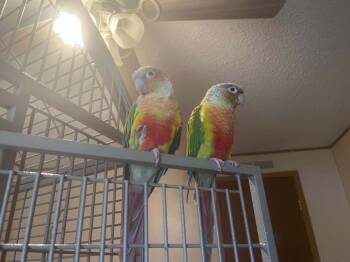
MOJO
Conure
🇺🇸
Pittsburgh, Pennsylvania
male, small, adult
Conure
Pittsburgh, Pennsylvania